How P2A Works
Turning routine clinical data into early, actionable insight that supports proactive care and reduces avoidable hospitalizations.
From Data to Action
SmithAI’s Prediction-to-Action (P2A) framework transforms existing clinical data into a structured workflow that enables earlier intervention.
Rather than stopping at prediction, P2A connects risk signals to real clinical processes so care teams can act before patients deteriorate.
The P2A Workflow
SmithAI Health’s P2A™ (Prediction-to-Action) framework transforms predictive analytics into operational workflows that care teams can actually use.
Clinical Data
Feature Table
Nightly Risk Scoring
Nurse Work Queue
Monitoring & Recalibration
Each step is designed to move from insight to action in a controlled and measurable way.
1
Clinical Data
Routine clinical data is extracted from the health system’s existing data environment.
This includes laboratory values, patient history, and other structured clinical inputs that already exist within normal care delivery.
No new data collection is required.
2
Structured Feature Table
Clinical data is organized into a standardized feature table designed for predictive modeling.
This step ensures consistency, reliability, and alignment with the intended clinical use case.
3
Risk Scoring
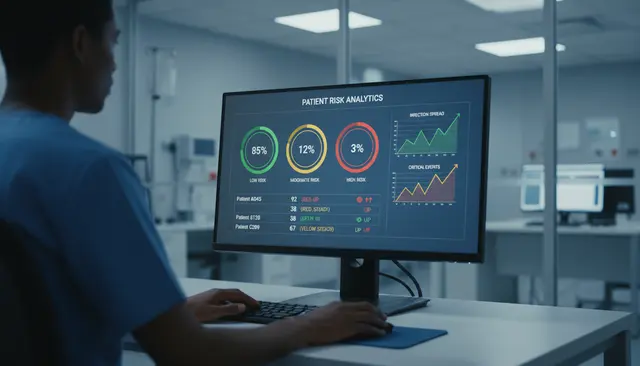
A predictive model evaluates patients on a recurring basis, typically nightly.
Each patient receives a risk probability and confidence range.
High-risk patients are prioritized into a nurse outreach call list, creating a clear, actionable workflow for early intervention.
This provides a structured view of patients at elevated near-term risk and enables care teams to act before conditions worsen.
4
Nurse Work Queue
High-risk patients are surfaced in a structured outreach queue.
This queue integrates into existing care management workflows, allowing nurses to:
- Conduct early outreach
- Assess symptoms
- Coordinate care
- Escalate when appropriate
The goal is simple: act earlier, not later.
5
Governance and Monitoring
P2A includes a governance layer that ensures models are used safely and effectively.
This includes:
- Calibration monitoring
- Drift detection
- Threshold management
- Ongoing performance review
Model outputs are continuously evaluated to maintain reliability over time.
Prediction Alone Is Not Enough
Many healthcare AI efforts stop at prediction.
In fact, most predictive models in healthcare never translate into real-world use.
P2A is designed to go further by connecting prediction to operational workflows, governance, and measurable outcomes.
This is where real impact is created.
Avoidable hospitalizations are not reduced by models alone. They are reduced when clinical teams can act on the right patients at the right time.

Where P2A Fits
Traditional systems focus on patient-level alerts within the EHR.
P2A operates at the system level.
It provides:
- Structured workflows for outreach
- Governance over thresholds and performance
- Measurement of system-wide impact
EHRs surface information.
P2A enables action.
Ready to See How This Fits Your System?
We work with health systems to align use cases, validate data, and implement P2A in a controlled, low-risk environment.